Weaving the Valley: How Each Community Tells Its Own Story in Thread
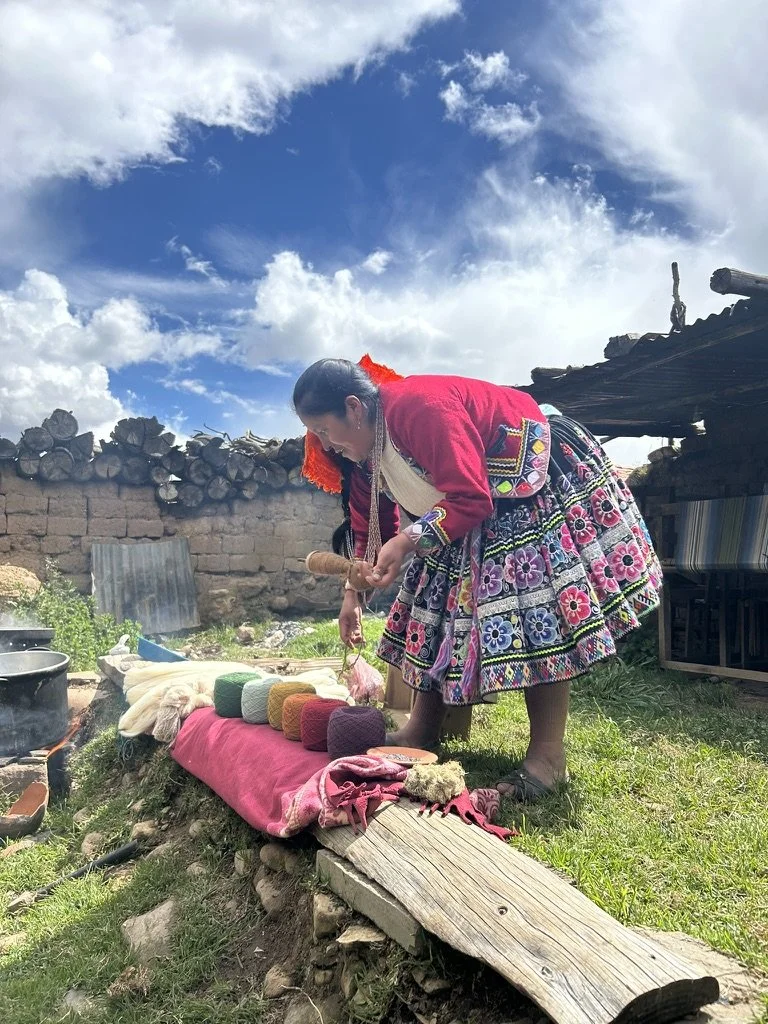
Walk through Huarán and you'll pass women carrying finished pieces on their backs — a manta, a chumpi, a chuspa — cloth made by their own hands. It's easy to see weaving here as background texture, part of the landscape like the mountains or the river. It isn't. It's one of the oldest continuous technologies in the Andes, and one of the few that never stopped.
The earliest evidence of textile-making in Peru dates back roughly 8,000 years, to basketry fragments found in Guitarrero Cave — long before anyone thought to call this place Peru, or the Inca had built a single wall. Cultures like Chavín, Paracas, and Nasca were already working with tapestry, embroidery, and natural dye long before the Inca arrived. What the Inca did was elevate it: they graded cloth by quality, from coarse domestic weavings up to qompi — nobility-grade textiles woven from baby alpaca and vicuña, with thread counts that could exceed 600 per inch. Spanish colonization tried to break the tradition; it didn't. Weavers kept the techniques alive in their own communities, quietly, for five centuries.
They're still doing it on a backstrap loom — a wooden frame tied around the weaver's waist at one end and anchored to a post, a tree, or a wall at the other. Leaning back tightens the warp; leaning forward releases it. It is, essentially, weaving with your whole body, and a single piece can take weeks. The fiber is usually alpaca (soft, warm) or llama (coarser, used for heavier textiles); the color still often comes from the same sources it always did — cochineal insects for reds and pinks, indigo for blue, plants and minerals for yellow, green, brown. You can tell a naturally dyed piece from a synthetic one at a glance, if you know what to look for: the synthetic colors sit brighter and flatter; the natural ones age softly instead of fading.
The patterns aren't decoration. A condor woven into a border signals the upper world and the spiritual; a puma, strength and the world of the living; a serpent, transformation. The chakana — the stepped Andean cross — holds all three worlds together in one symbol. The hummingbird, q'ente, stands for reciprocity and care. None of this is arbitrary, and none of it is fixed, either — which is the part that surprised me most.
There is no single Sacred Valley "style." A llama woven in one village doesn't look like a llama woven in the next one over. A community an hour's drive away might use an entirely different color logic, a different density of pattern, a different relationship to negative space — shaped by what dyes were locally available, who trained whom, and generations of small decisions that hardened into a recognizable local hand.
This valley isn't one village but five smaller settlements spread across the lower Sacred Valley and the highlands above it, and the weavers among them work together as a cooperative that outside textile organizations have described as some of the most technically skilled and best-coordinated they work with anywhere in the region — capable of reproducing even the most difficult custom designs with real precision, and developing original designs of their own. That's not folklore. That's a working textile economy, run by people who live a short walk from where you're likely reading this.
It's worth sitting with that for a second: the loom that made the textile on your bed, or the one folded in a market stall in Pisac, might trace back not to some abstract "Andean tradition" but to a specific set of hands, in a specific village, working a technique passed down through a specific family line — one that predates the Inca, survived the Spanish, and is still, this week, tied around someone's waist in Huarán.
Interested in learning more about Andean weaving? We offer an incredible opportunity to visit a local weaving family’s home and see first-hand the process that transforms the alpaca fibers (alpaca also tended to by the family) into astonishingly beautiful shawls, scarves, bags & ponchos. Reach out to find out more.